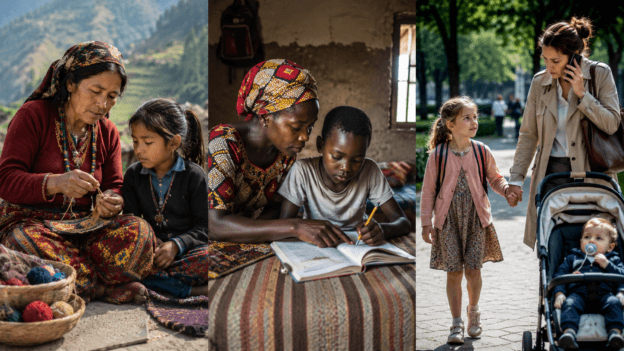


Author Archives: Lexi

IQ Tests Fail Across Cultures

An IQ score is often treated as something definitive.

A number that claims to measure intelligence. A way to compare people across countries and cultures.

But there’s a problem with that idea.

What one society considers “smart” may look very different in another. The skills people develop depend on their environment, the problems they face, and what their culture values.

So what exactly are IQ tests measuring?

IQ tests were developed within a Western framework. They prioritize certain types of thinking like abstract reasoning, pattern recognition, and language-based problem solving.

These are useful skills, but they are not universal measures of intelligence.

When these tests are applied across cultures, they do more than assess ability. They measure how closely someone’s thinking aligns with the assumptions built into the test.

In that sense, the test is not neutral.

It reflects a specific worldview.

This becomes clear when looking at how intelligence shows up in different environments.

In a well-known study from the 1990s, researchers observed Brazilian street children who relied on selling goods to survive. Their daily lives required quick mental math, negotiation, and real-time decision-making under pressure.

On the street, they performed complex calculations with accuracy.

But in a classroom setting, many of these same children struggled with basic math problems.

The issue was not intelligence. It was context.

The way they applied math in real life did not match the way it was presented in school. When the format changed, their ability became harder to recognize.

This highlights a broader point.

Problem-solving is shaped by environment. Intelligence is not just about abstract thinking, it is about how effectively someone navigates the world they live in.

IQ tests only capture a narrow slice of that.

They can be useful in specific settings. But when used to compare people across cultures, they risk oversimplifying something far more complex.

Because intelligence is not just a score.

It is context, lived experience, and adaptation.

KKK or Semana Santa? What You’re Really Seeing in Spain

For someone seeing Spain’s Semana Santa processions for the first time, the reaction can be immediate.
Rows of hooded figures move slowly through candlelit streets. Their faces are hidden beneath tall, pointed hoods. The atmosphere is quiet and solemn.

To many American viewers, the image can raise an uncomfortable question. Why does this look like the Ku Klux Klan?

It’s a reaction that occasionally appears online when photos of Spain’s Holy Week circulate without context. But the answer reveals a much older story and a reminder that cultural traditions often look very different when viewed outside their history.

Semana Santa, or Holy Week, is one of Spain’s most important religious observances. Held during the week leading up to Easter, it commemorates the Passion of Christ. Across cities like Seville, Málaga, and Granada, centuries-old brotherhoods known as cofradías organize elaborate processions through the streets.

Large religious sculptures depicting scenes from the final days of Christ’s life are carried on heavy platforms by costaleros. Surrounding them are participants known as nazarenos, dressed in long robes and tall pointed hoods called capirotes.

It is the capirote that often surprises outsiders.

The hood has deep historical roots in Spain. In medieval times, individuals performing acts of public penance would cover their faces as a sign of humility and repentance. Over time, this tradition became part of Holy Week processions. The pointed hood allowed participants to remain anonymous, emphasizing that the act of devotion was directed toward God rather than public recognition.

In other words, the hood was never meant to draw attention. It was meant to remove it.

These garments have existed in Spanish religious traditions for centuries, long before the Ku Klux Klan adopted its own hooded robes in the United States. While the visual similarity can be striking, the meanings could not be more different.

Where the KKK’s robes became symbols of racism and intimidation, the capirote represents humility, penance, and spiritual reflection.

Within Spain, the imagery carries none of the associations that Americans might immediately see. Instead, it is recognized as part of a deeply rooted cultural and religious tradition passed down through generations.

Semana Santa is not simply a religious ritual. It is also a cultural event that brings entire communities together. Families gather to watch the processions, streets fill with spectators, and centuries-old brotherhoods maintain traditions that connect the present with the past.

To those encountering it for the first time, the symbolism may take a moment to understand.

But like many traditions around the world, Semana Santa reveals how cultural practices often carry layers of meaning that aren’t immediately visible to outsiders.

Sometimes what looks unusual at first glance turns out to be something much deeper.

Photo by Sebastián Valencia Pineda

The Purpose of Fasting Across Cultures

Each year during Lent, many Christians fast or give up certain foods. For people outside the tradition, the question often arises: why?

In modern wellness culture, fasting is often framed as a health strategy. It is promoted for metabolism, weight loss, or “detoxification.” But the biology is more complex than many headlines suggest.

When people go without food, blood sugar levels change and the body shifts how it produces energy. For some individuals, structured fasting can be tolerated well. For others, especially when done incorrectly or without regard for personal health, it can lead to fatigue, hormonal disruption, or unstable blood sugar. The effects vary widely between individuals and can differ significantly between men and women.

Which raises a curious point: if fasting is not universally beneficial from a health perspective, why has it appeared in so many religious traditions?

Across cultures, fasting has rarely been about nutrition alone.

In Christianity during Lent, in Islam during Ramadan, and in Judaism during Yom Kippur, fasting functions as a form of spiritual discipline. It interrupts routine and invites reflection.

Historically, these practices emerged long before the modern wellness industry. They were not designed to optimize metabolism or extend longevity. Instead, they asked something more difficult: to voluntarily step away from comfort.

In a world where food and convenience are increasingly constant, that idea can feel counterintuitive.

Fasting introduces discomfort. Hunger becomes noticeable. Habits are interrupted. And in that interruption, people are often reminded of something larger than themselves.

For many traditions, that experience serves several purposes. It encourages self-discipline. It creates space for prayer or reflection. And it can sharpen awareness of those who experience hunger not as a choice, but as a daily reality.

In that sense, fasting is less about purification and more about perspective.

It asks people to momentarily set aside convenience and self-interest in order to reflect on gratitude, empathy, and spiritual priorities.

The practice may look like a dietary restriction from the outside.

But in many religious traditions, its purpose has always been much deeper than food.

The Cultural Genome of Fertility

In the United States, it is increasingly common to hear that children feel financially out of reach.

Housing is expensive. Childcare is expensive. The numbers feel daunting.

But if cost alone determined family size, countries like Finland and Sweden would be leading the world in birth rates. These nations provide extensive parental leave, strong public support systems, and subsidized childcare, yet fertility continues to decline.

Which suggests something else is at work.

Culture does not just influence how families function. It influences how large they become.

In highly individualistic societies like the United States, adulthood is often framed around independence and personal achievement. People are encouraged to establish careers, pursue self-expression, and build lives centered on individual goals. Children may be deeply desired, but raising them is typically understood as the responsibility of the parents themselves.

In more interdependent cultures across parts of Latin America, Asia, and Africa, family life is structured differently. Grandparents play active roles. Aunts and uncles remain closely involved. Extended relatives contribute to daily care, guidance, and support.

Within that structure, children grow up connected to a wider network. From an early age, they understand that their actions reflect on the family as a whole, reinforcing a shared sense of identity across generations.

Because care and responsibility are distributed across that network, raising children is often understood as a collective effort rather than a private undertaking confined to a single household.

Religion can also shape family expectations in some societies, particularly where faith remains closely tied to identity and tradition. But even in many of those contexts, birth rates are shifting as education expands and urban life evolves.

Across the globe, fertility patterns are changing.

But the cultural framework remains powerful.

Where family is organized as a collective effort, larger families are more common.

Where family is structured primarily as a private responsibility, smaller ones often follow.

Culture does not dictate the decision.

It shapes the environment in which the decision is made.

And that environment has a measurable impact on how many children families ultimately choose to have.

Legally Fired By AI? A Court Just Said Yes.

A translator in Spain was recently laid off.

Her employer argued that revenue had dropped as clients began relying more heavily on AI tools. She challenged the termination in court.

She lost.

In a country where judges typically favor continued employment, the court accepted that revenue decline tied to AI-driven market shifts could justify dismissal. It was a small case with a larger signal: technological disruption is no longer abstract. It is measurable. And now, in at least one instance, legally acknowledged.

But this is not a story about one translator.

It is a story about transition.

Every meaningful technological leap reshapes work. When spreadsheets replaced ledger books, accountants did not disappear. Their role evolved. When digital photography overtook film, the tools changed, but the demand for vision did not.

AI has entered the labor law forum.

The more useful question is not “Will AI take jobs?” It is “What do I bring that AI cannot replicate?”

This ruling suggests that courts may increasingly recognize AI-driven market change as economic reality.

Change is rarely comfortable. But it is not inherently catastrophic. It is directional.

The professionals who thrive in the next phase will be the ones who understand the tools, expand their expertise, and lean into the parts of their work that cannot be replicated.

The conversation is no longer about whether AI is coming. It is about how we choose to meet it.

Stress Is Global. Coping Is Cultural.

Stress doesn’t need a passport. It shows up in crowded calendars, growing expectations, and the steady pressure of modern life. What changes across borders is not the presence of stress itself, but the way people respond to it.

It’s been shown that one of the most consistent factors shaping how people navigate stress across cultures is connection. When people feel supported and understood, stressful situations often feel more manageable. In many parts of the world, that reassurance is not something people have to actively seek out. It is embedded in daily life.

In more interdependent cultures, such as Italy or Mexico, close relationships are central to everyday experience. Family and friends remain actively involved, and emotional connection is maintained through frequent interaction. Stress is often discussed openly and shared naturally, moving through social networks rather than settling entirely on one person.

In more individualistic cultures, including the United States, independence and self-reliance are more strongly emphasized. People are often expected to manage pressures privately before reaching outward. Support still exists, but it may be accessed later, once stress has already intensified, rather than serving as the first response.

How people see themselves also shapes how they deal with stress. In cultures where identity is closely tied to relationships and community, self-esteem is reinforced through belonging and shared roles. That steady reinforcement can act as a buffer during difficult periods. When people feel grounded in their connections, challenges are less likely to feel like personal failures and more like situations that can be navigated together.

In more independent cultures, the dynamic shifts. Self esteem is more closely tied to personal achievement and internal standards. When plans falter or expectations are unmet, stress can feel personal and harder to shake, especially when there is a cultural expectation to resolve it alone.

These differences aren’t about which culture handles stress better. They show how culture shapes the expectations people carry about strength, resilience, and support. Stress may be universal, but whether it is faced alone or eased through connection is learned. Recognizing that difference allows us to see stress not just as an individual burden, but as something deeply influenced by the communities around us.

Why Driving Styles Differ Around the World

How Culture Shapes the Way We Drive

Driving may feel like a purely practical activity: get in the car, follow the rules, get where you’re going. But how people actually behave behind the wheel tells a much bigger story. Across the world, driving styles vary widely, not because people are better or worse drivers, but because culture shapes how risk, control, emotion, and personal freedom are understood.

Research consistently shows that driving behavior reflects deeper cultural values.

Driving as a Cultural Expression

Studies comparing driving styles across countries reveal clear patterns. For example, research by Xu and Sun found that Chinese drivers tend to exhibit higher levels of anxious, angry, and risk-prone driving behaviors when compared to drivers in the United Kingdom. This doesn’t mean Chinese drivers are inherently reckless. Rather, it reflects the environment they drive in.

In highly congested cities, where traffic is dense and road conditions change quickly, drivers often develop a more assertive style. Honking, rapid lane changes, and close following distances become coping mechanisms in a system that feels unpredictable. Anxiety and urgency behind the wheel are responses to constant external pressure.

By contrast, UK driving culture emphasizes predictability, rule-following, and emotional restraint. Roads are structured, enforcement is consistent, and social norms discourage overt displays of frustration. As a result, driving tends to feel calmer, even in busy areas.

Risk, Freedom, and Control

Other studies highlight how cultural values influence decision-making on the road. Zhang’s research comparing Japanese and American drivers points to a clear divide in how risk is approached.

Japanese drivers tend to prioritize risk avoidance. Caution, anticipation, and smooth traffic flow are valued. This aligns with broader cultural norms that emphasize harmony, responsibility, and minimizing disruption to others. Defensive driving is not just a safety choice — it’s a social one.

American drivers, on the other hand, often prioritize personal freedom. Driving is closely tied to independence, autonomy, and identity. This can translate into higher risk tolerance: faster speeds, assertive maneuvers, and a belief that individual judgment outweighs collective flow.

Neither approach is inherently right or wrong. Each reflects what a society values — safety versus autonomy, predictability versus flexibility.

Emotions Behind the Wheel

Cultural attitudes toward emotion also play a role. In some cultures, expressing frustration or urgency openly is acceptable. In others, emotional restraint is expected, even under stress.

These norms shape how drivers respond to traffic delays, mistakes by others, or unexpected obstacles. What looks like aggression from the outside may actually be a culturally learned response to pressure.

Why This Matters

Understanding cultural differences in driving is important not just for travelers, but for urban planners, policymakers, and anyone working in global mobility or transportation. Road design, enforcement strategies, and safety campaigns that work in one country may fail in another if they don’t align with cultural expectations.

Driving is not just about rules, it’s about trust, cooperation, and how people navigate shared space.

So the next time you’re on the road abroad and notice driving that feels chaotic or overly cautious, it may help to remember: you’re not just seeing traffic. You’re seeing culture in motion.

two women exchange chocolate gifts in celebration of valentines day.

Love, Everywhere: A Valentine’s Day Look Around the World

Valentine’s Day has a reputation. Hearts, roses, cards, dinner reservations, a certain kind of romance that feels very familiar. But that version of the holiday is only one interpretation. Look a little closer, and Valentine’s Day becomes less predictable and far more interesting.

In one place, love might arrive wrapped in ribbon. In another, it’s passed quietly across a desk. The same date on the calendar can signal a romantic evening, a friendly exchange, or a simple acknowledgment that someone matters.

In Japan, Valentine’s Day often centers on the act of giving. Chocolates are chosen carefully and shared widely, not only with romantic partners, but with friends, classmates, and coworkers too. The meaning lives in the gesture itself, thoughtful and intentional. A month later, White Day completes the exchange, turning the holiday into an ongoing conversation rather than a single moment. In South Korea, that rhythm stretches even further, with additional days throughout the year dedicated to marking different kinds of relationships, blending affection with a light sense of humor.

Travel a bit farther, and Valentine’s Day begins to feel more social. In parts of Latin America, the holiday is as much about friendship as it is about romance. Small gifts are exchanged between friends, messages are shared freely, and time together takes center stage. Love here feels open and collective, something meant to be celebrated with many people rather than just one.

In Northern Europe, the tone often softens. In countries like Finland and Estonia, Valentine’s Day leans toward friendship and simplicity. There’s less emphasis on spectacle and more room for quiet gestures. A card, a message, a brief reminder of connection can be enough.

Seen this way, Valentine’s Day becomes less about a single idea of love and more about the many ways people express care and appreciation. Chocolates, notes, shared time, or quiet acknowledgments all carry meaning, shaped by the places and cultures they belong to.

Looking at Valentine’s Day around the world offers a gentle reminder. Love doesn’t need to follow one script to be meaningful. Sometimes it’s celebrated loudly, sometimes gently, and sometimes in ways that feel almost ordinary. And it’s often those small, familiar moments that make it worth noticing.

The Salesman Personality: Why Boastfulness Works in the U.S. (and Often Doesn’t Elsewhere)

Every culture has a different relationship with confidence. In some places, selling yourself loudly is admired. In others, it’s viewed with suspicion. Few personality types highlight this divide more clearly than the classic “salesman” persona: bold, boastful, persuasive, and unapologetically self-promoting.

In the United States, this style is not only familiar, it’s often rewarded.


The American Comfort with Self-Promotion

American culture has long valued visibility, ambition, and personal branding. From job interviews to politics to entrepreneurship, individuals are encouraged to “sell themselves,” highlight achievements, and project confidence, even if that confidence borders on exaggeration.

The salesman personality fits neatly into this framework. Boastfulness can be interpreted as strength. Hyperbole is often forgiven as enthusiasm. Success is measured not only by results, but by the ability to convince others of one’s vision.

In this cultural context, loud confidence signals leadership. Doubt or restraint can be mistaken for weakness. As a result, highly assertive figures often gain attention, loyalty, and influence, even when their claims are challenged.


Why the Same Behavior Feels Wrong Elsewhere

Outside the U.S., the same behavior often lands very differently.

In many cultures, boasting is associated with insecurity, immaturity, or a lack of credibility. Trust is built through consistency, humility, and demonstrated competence rather than verbal self-praise. People expect others to “let their work speak for itself.”

In these contexts, overt self-promotion can feel uncomfortable or even disrespectful. Exaggerated claims raise red flags. Confidence is still valued, but it is expected to be quiet, measured, and proportional.

This difference explains why some American public figures or business leaders are admired domestically but viewed skeptically abroad. The behavior itself isn’t new; the interpretation is.


High-Context vs. Low-Context Communication

Cultural communication styles help explain the gap.

The U.S. is generally considered a low-context culture, where messages are explicit, direct, and verbal. Saying what you want clearly (and repeatedly) is seen as effective communication.

Many other cultures operate in higher-context environments, where meaning is conveyed through tone, behavior, history, and restraint. In those settings, excessive self-praise disrupts social balance and undermines credibility.

In short:

  • In the U.S., confidence is often proven by assertion.
  • Elsewhere, confidence is proven by restraint.


The Risk of Misreading the Room

The global challenge with the salesman personality is not whether it’s “good” or “bad,” but whether it translates.

What energizes one audience may alienate another. What sounds decisive in one culture may sound arrogant in another. Without cultural awareness, boldness becomes noise.

This is especially important in global business, diplomacy, and leadership. Persuasion is never universal. It depends on shared expectations about humility, authority, and trust.


Confidence Is Cultural

Boastful behavior isn’t inherently effective or ineffective, it’s culturally specific.

Understanding how different societies respond to confidence allows leaders and communicators to adapt rather than assume. The most successful global figures aren’t the loudest in every room. They’re the ones who know when to speak boldly, and when to let silence do the work.

To Breastfeed or Not To Breastfeed

The question of whether to breastfeed is often framed as a personal choice, guided by health advice, convenience, or individual comfort. But around the world, infant feeding is shaped by far more than personal preference. It is deeply influenced by culture, social norms, public policy, and how societies view women’s bodies.

In many Western countries, breastfeeding is strongly encouraged by medical institutions, yet socially complicated in practice. New parents are told that “breast is best,” while simultaneously receiving mixed messages about when and where breastfeeding is acceptable. Public breastfeeding can still spark discomfort or criticism, placing parents in a contradictory position: expected to breastfeed, but only discreetly.

In contrast, in cultures where breastfeeding is openly normalized, the act itself carries little social weight. Feeding a baby in public is seen as routine, practical, and unremarkable. There is no expectation to hide, cover up, or explain. In these societies, breastfeeding is not a statement, it is simply caregiving.

Elsewhere, formula feeding may be more common, not because of stigma around breastfeeding, but due to economic realities, workplace expectations, or historical influence. In countries where maternity leave is short or informal employment is widespread, breastfeeding can be difficult to sustain. Feeding choices reflect structural constraints rather than individual values.

Cultural attitudes toward modesty also play a significant role. In societies with strict expectations around women’s bodies, breastfeeding may be limited to private spaces, even if it is encouraged in principle. The result is often emotional pressure: parents feel responsible for meeting health ideals while navigating social discomfort.

There is also the influence of generational norms. In some cultures, older family members strongly shape infant feeding decisions, passing down beliefs about strength, nutrition, or tradition. In others, parents rely more heavily on medical guidance or peer communities. These differences can lead to tension, especially when cultural expectations clash with modern health messaging.

What often gets lost in these conversations is the reality that no feeding decision exists in a vacuum. Breastfeeding and formula feeding are both shaped by access, support, education, and social acceptance. A culture that truly supports breastfeeding doesn’t just promote it, it makes space for it. That means parental leave, flexible work environments, and public attitudes that treat infant feeding as normal rather than controversial.

At the same time, cultures that value choice recognize that feeding decisions are not moral judgments. Parents may choose formula for medical reasons, mental health, work demands, or personal comfort. Supportive cultures allow for these choices without shame.

Ultimately, the question of whether to breastfeed is not just about nutrition. It’s about how societies support caregivers, how they view women’s bodies, and how comfortable they are with the visible realities of care.

Understanding breastfeeding as a cultural issue (rather than a personal failure or success) allows for more empathy, better policy, and healthier conversations around early parenthood.