


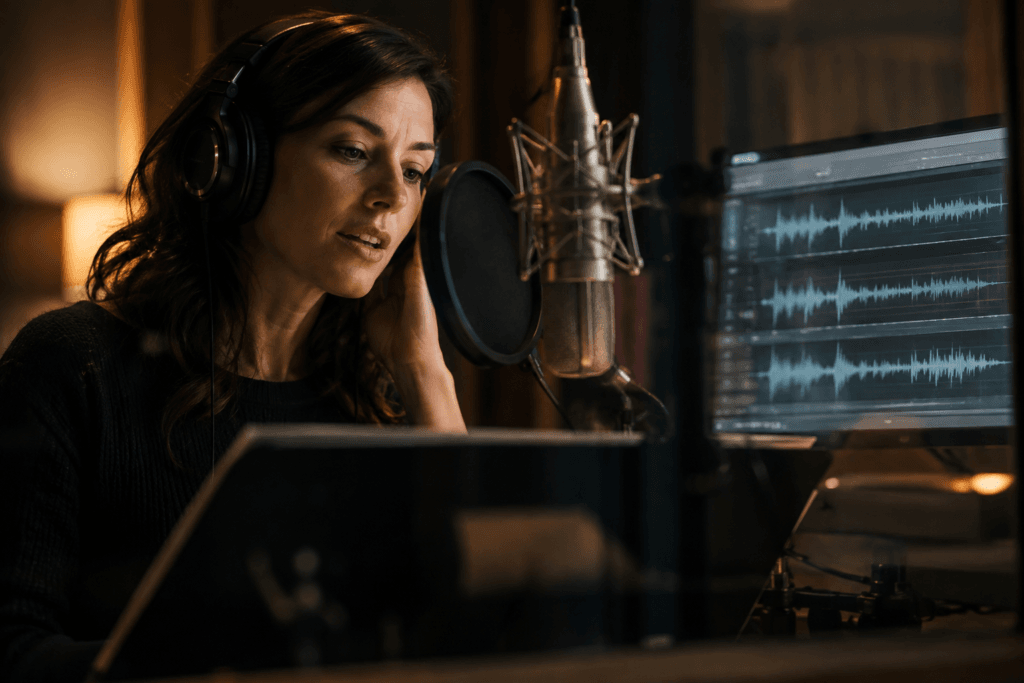
A voice actor records a commercial.
The session ends. The files are delivered. Everyone moves on.
But what happens when that recording can be used to create an entirely new performance without the actor ever stepping in front of a microphone?
That’s the question AI voice technology is forcing the industry to answer.
AI can now clone a person’s voice and generate new speech in different styles, languages, tones, and emotional ranges. A voice can be made conversational, dramatic, monotone, or energetic without requiring the actor to record every new line.
That creates enormous opportunities for businesses.
It also creates a new set of rights to consider.
Before licensing a voice for AI use, the most important question isn’t simply, “How much does it cost?”
It’s “What exactly are you allowed to do with it?”
A strong agreement should clearly define how the voice replica will be created and used, who can access it, what types of content it can generate, how long the rights last, and what happens when that period ends.
Compensation matters too.
Traditional voiceover has established rates based on recording time, usage, territory, and duration. AI voice licensing is still developing, so there isn’t always a simple comparison. The value depends on what rights are being granted and how extensively the replica can be used.
The industry is already moving toward clearer standards. SAG-AFTRA’s recent agreements emphasize three principles: consent, compensation, and control. Current provisions require informed consent for creating and using digital replicas, specific descriptions of intended use, compensation for generated performances, and protections for the security of voice data.
That’s an important shift.
With AI voiceover, you’re not simply hiring someone to read words. You’re potentially licensing a digital version of their voice.
The recording may end in the studio. The rights don’t have to.