


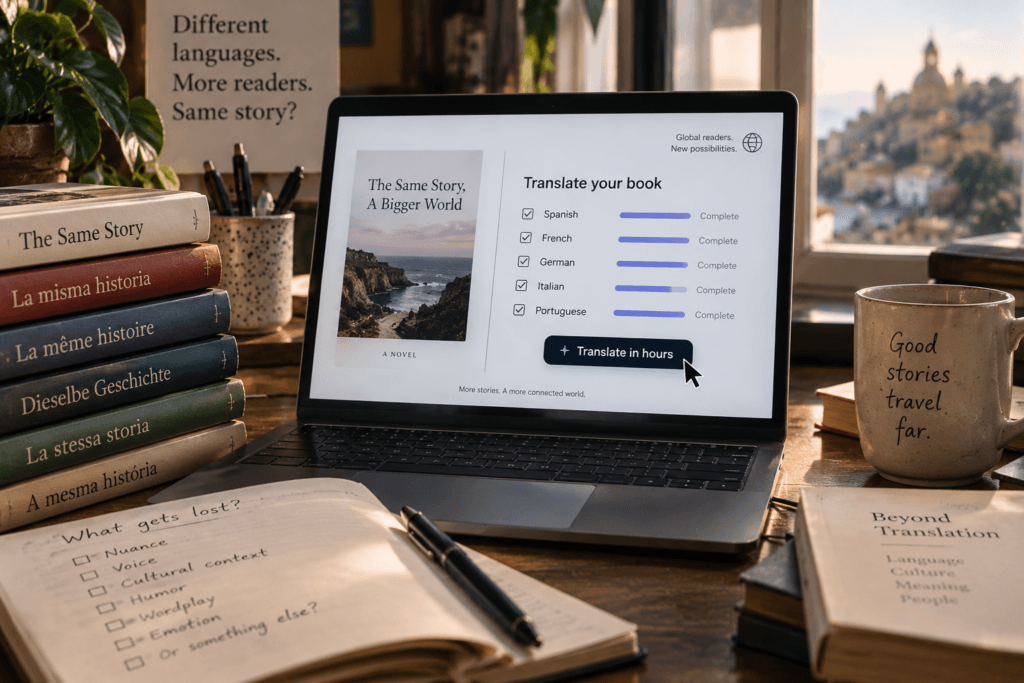
Imagine finishing your book and being told you can make it available to readers in five more languages – without hiring five translators, waiting months, or paying for the work.
That is essentially the promise behind Amazon’s Kindle Translate.
Amazon’s AI-powered service allows eligible Kindle Direct Publishing authors to create eBook translations in just a few clicks. The service is currently free during its beta period, and translations can be created in hours rather than the weeks or months traditionally associated with a book-length translation.
It sounds almost too easy.
And that raises an interesting question: what do readers expect when they pick up a translated book?
For some books, the answer may be fairly simple. If the goal is to explain how to do something, share business advice, or tell a straightforward story, an accurate and readable translation can go a long way.
But a novel asks for something more.
A novel has a voice. It has rhythm, humor, personality, wordplay, cultural references, and all the little choices that make an author’s writing feel like their writing.
Amazon knows this distinction exists. Its own guidance says Kindle Translate tends to work well with fiction, business books, self-help, straightforward instructional content, and standard prose. But it also acknowledges limitations with complex literary devices, wordplay, poetry, intricate creative language, and books with extensive cultural references.
And Amazon does have quality controls. Its seven-step system checks for things like mistranslations, idioms, terminology, omissions, grammar, and consistency before a translation can be published. But authors currently cannot directly edit the translated text inside Kindle Translate.
That’s where the difference between translating words and translating a work becomes important.
A skilled literary translator isn’t simply looking for the equivalent word in another language. They’re listening for the author’s voice and trying to recreate the experience for someone who speaks a different language. Translation research has long treated voice, rhythm, style, cultural meaning, and reader experience as part of that creative challenge.
So is Kindle Translate a good idea?
It depends on the book – and on what the author and reader expect from the translation.
Amazon may have made the first part of the process dramatically faster and cheaper.
The bigger question is whether “fast and good enough” is always enough for a book worth reading.