


What people find attractive often feels natural, obvious, even universal.
But beauty has always been shaped by culture.
What one society admires, another may barely notice. Features considered beautiful in one part of the world may carry completely different meanings somewhere else, and those standards continue to shift over time.
In ancient societies, fuller figures were often associated with beauty because they represented wealth, health, and access to food during times where resources were limited. Today, entirely different features may be emphasized depending on where you are in the world and what a culture has historically valued.
Even skin tone is viewed differently across cultures. In some countries, darker skin with more melanin is admired and celebrated, while in places like Japan, lighter skin has historically been associated with beauty and social status.
And some beauty standards are deeply tied to cultural identity itself.
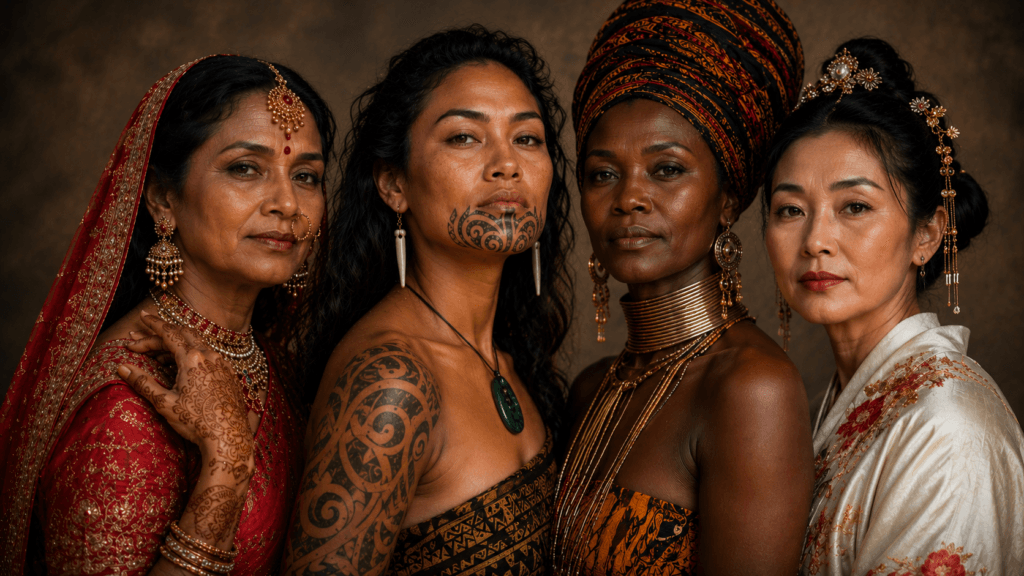
In Japan, “yaeba” teeth, slightly crooked or overlapping teeth, are sometimes viewed as attractive because they are associated with youthfulness and charm. In some African cultures, stretched earlobes and neck rings are seen as beautiful traditions connected to heritage and identity. In Indigenous and Islander cultures, traditional tattooing for women can symbolize ancestry, spirituality, strength, and beauty all at once.
What makes these standards interesting is not whether one is “better” than another.
It’s that people often grow up believing their version of beauty is simply normal.
But much of what we find attractive is shaped long before we consciously realize it. The people around us, the features celebrated in media, the traditions we inherit, and the culture we grow up in all influence what we come to recognize as beautiful.
Even studies involving identical twins, people with nearly identical DNA, have shown that they are often attracted to completely different people. That suggests attraction is influenced by far more than biology alone.
Of course, some traits appear more consistently across cultures. Facial symmetry, for example, is often associated with attractiveness globally.
But beyond a few shared patterns, beauty is far from universal.
It is cultural, contextual, and constantly evolving.