


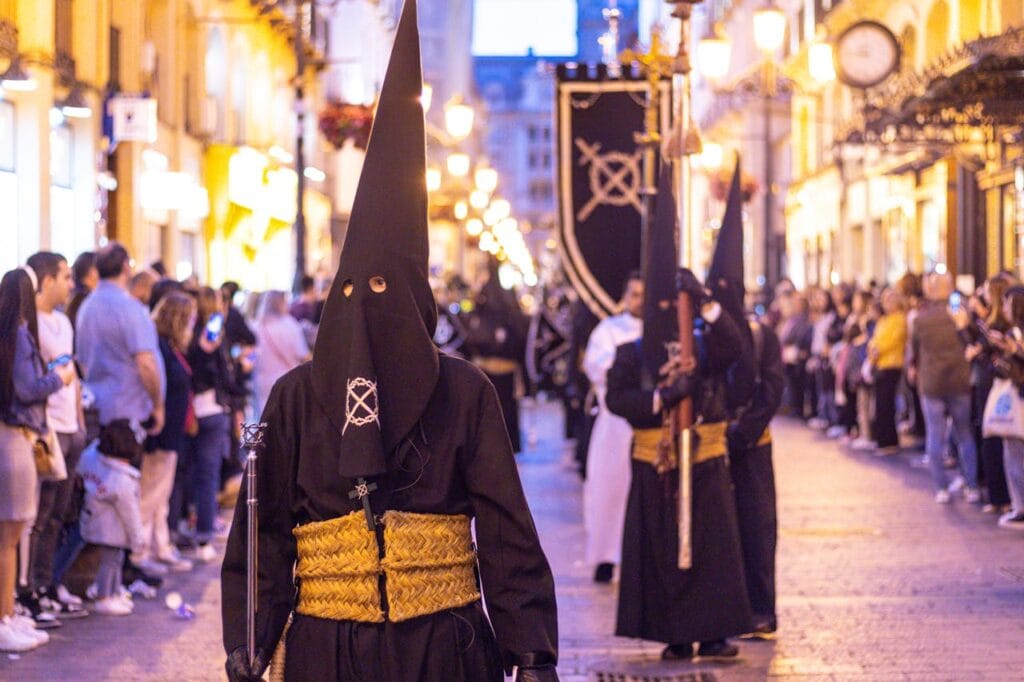
For someone seeing Spain’s Semana Santa processions for the first time, the reaction can be immediate.
Rows of hooded figures move slowly through candlelit streets. Their faces are hidden beneath tall, pointed hoods. The atmosphere is quiet and solemn.
To many American viewers, the image can raise an uncomfortable question. Why does this look like the Ku Klux Klan?
It’s a reaction that occasionally appears online when photos of Spain’s Holy Week circulate without context. But the answer reveals a much older story and a reminder that cultural traditions often look very different when viewed outside their history.
Semana Santa, or Holy Week, is one of Spain’s most important religious observances. Held during the week leading up to Easter, it commemorates the Passion of Christ. Across cities like Seville, Málaga, and Granada, centuries-old brotherhoods known as cofradías organize elaborate processions through the streets.
Large religious sculptures depicting scenes from the final days of Christ’s life are carried on heavy platforms by costaleros. Surrounding them are participants known as nazarenos, dressed in long robes and tall pointed hoods called capirotes.
It is the capirote that often surprises outsiders.
The hood has deep historical roots in Spain. In medieval times, individuals performing acts of public penance would cover their faces as a sign of humility and repentance. Over time, this tradition became part of Holy Week processions. The pointed hood allowed participants to remain anonymous, emphasizing that the act of devotion was directed toward God rather than public recognition.
In other words, the hood was never meant to draw attention. It was meant to remove it.
These garments have existed in Spanish religious traditions for centuries, long before the Ku Klux Klan adopted its own hooded robes in the United States. While the visual similarity can be striking, the meanings could not be more different.
Where the KKK’s robes became symbols of racism and intimidation, the capirote represents humility, penance, and spiritual reflection.
Within Spain, the imagery carries none of the associations that Americans might immediately see. Instead, it is recognized as part of a deeply rooted cultural and religious tradition passed down through generations.
Semana Santa is not simply a religious ritual. It is also a cultural event that brings entire communities together. Families gather to watch the processions, streets fill with spectators, and centuries-old brotherhoods maintain traditions that connect the present with the past.
To those encountering it for the first time, the symbolism may take a moment to understand.
But like many traditions around the world, Semana Santa reveals how cultural practices often carry layers of meaning that aren’t immediately visible to outsiders.
Sometimes what looks unusual at first glance turns out to be something much deeper.
Photo by Sebastián Valencia Pineda